
 3 minutes
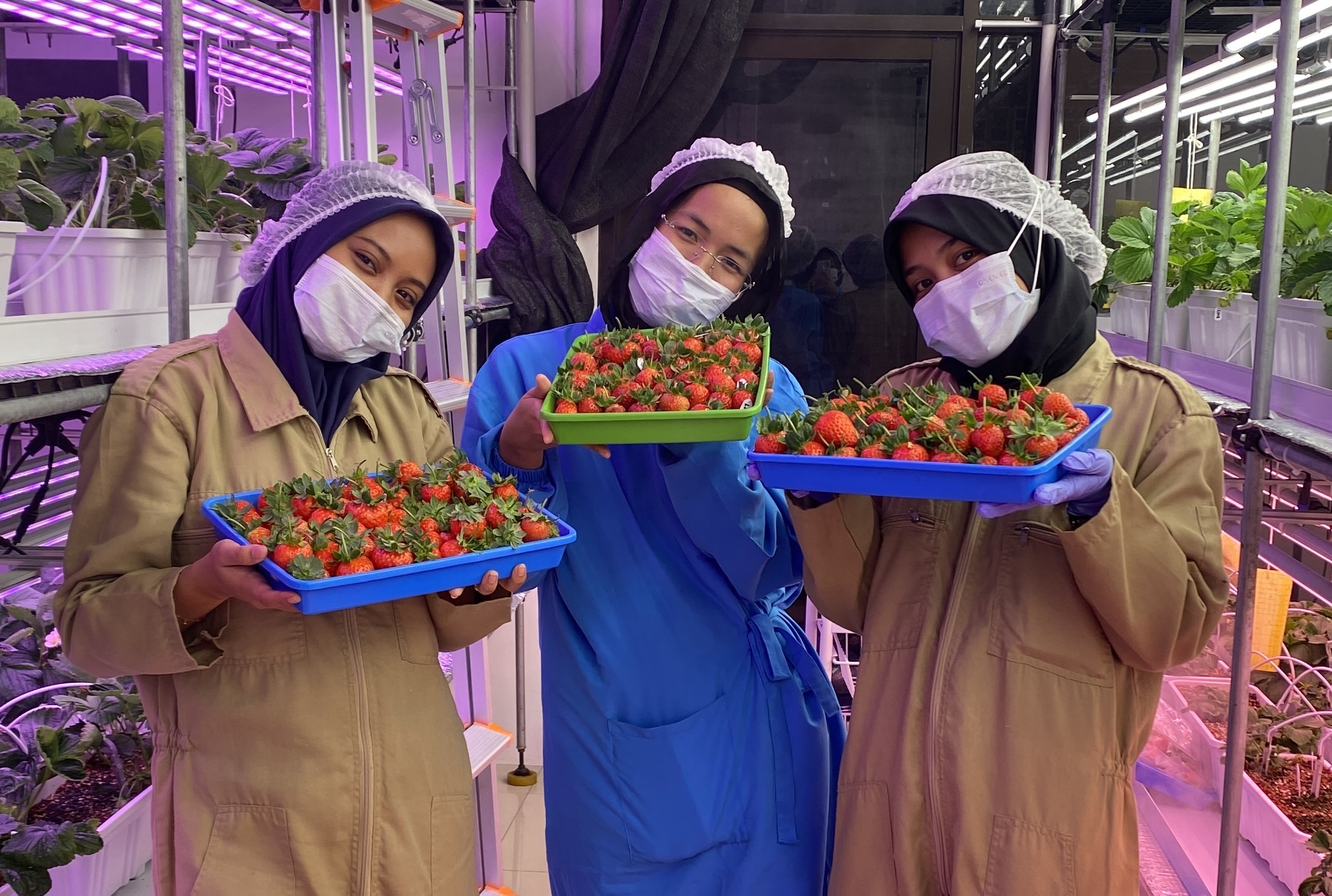
As agrotechnology continues to grow, PT Inamas Sintesis Teknologi, a startup from Jogja, has successfully developed strawberry indoor farming known as the Strawberry Plant Factory. This system is a smart innovation aimed at creating sustainable modern farming practices. It is designed to address global challenges such as climate change, food security, and the need for efficient land use. The excellence of the development lies in an automated monitoring system named MyLestari. MyLestari, a product designed by INASTEK, monitors plant growth by automatically adjusting environmental conditions such as microclimate and nutrient scheduling.

The comprehensive system of the Strawberry Plant Factory simplifies plant care and produces high-quality strawberries. This was evident during the first harvest, which yielded strawberries weighing up to 39.3 grams. The strawberries are categorized into four grades: Grade S (>30 grams), Grade A (20-30 grams), Grade B (15-20 grams), and Grade C (<15 grams). During the harvest period, INASTEK invited faculty members from the Faculty of Agriculture and the Faculty of Agricultural Technology at UGM to taste and evaluate the strawberries firsthand. "I am very pleased because my dream during my PhD studies in Japan has finally come true. The strawberries also taste delicious and sweet," said Dr. Affan Fajar Fallah, a faculty member from the Faculty of Agricultural Technology at UGM.

The 39.3 gram strawberries can still be optimized to reach 50 grams. Despite the satisfactory results of the harvest, INASTEK will continue to further develop the strawberries to increase their market value. "This harvesting marks the culmination of our research journey in cultivating indoor strawberry commodities. Our company remains enthusiastic about synergizing with universities to create sustainable modern agriculture," said Yosef Adhitya Duta Dewangga, CEO of PT Inamas Sintesis Teknologi.

As part of their commitment to collaboration, the Faculty of Agriculture at UGM plans to establish a similar plant factory to promote Smart Eco-Bio Production. Dean Ir. Jaka Widada, M.P., Ph.D., explained that advanced technologies like this are being developed on campus to serve as learning environments for young people, fostering interest in agriculture. Moreover, students can gain a deeper understanding of IoT applications from planting and maintenance to harvesting and business aspects of agricultural commodities. "I greatly appreciate PT Inamas Sintesis Teknologi's efforts in developing this technology at a time when land scarcity is challenging the paradigm for traditional farming to shift towards technology-based systems," said Prof. Dr. Ir. Irham, M.Sc., Chairman of the Senate at the Faculty of Agriculture, UGM.
 Share
Share


